 fairfits.co
article · accent chairs · 7 min read
What Type of Accent Chair Works Best in a Small Living Room?
A small living room does not necessarily need a small-looking chair. Sometimes the chair that anchors the room is exactly what keeps it from feeling like a collection of furniture pushed against the walls.
An armless chair keeps the edges quiet
Start with what the chair has to do. Its footprint has to fit; you need room to approach and use it, and the route past it still has to work. Once those checks pass, the useful question is not simply which chair is smallest. It is what kind of chair earns the floor it takes.
An armless accent chair removes two of the strongest horizontal edges from the silhouette. More floor and background remain visible around the seat, so the chair can sit close to other furniture without creating one continuous block of upholstery.
That makes an armless chair useful in rooms that already have enough visual mass: beside a substantial sofa, near a deep media cabinet, or in a corner where another broad piece would make the furniture feel packed together.
The trade-off is real. Arms give you somewhere to settle an elbow and make a chair feel more contained. Removing them changes the experience and the silhouette.
Use an armless chair when you want the seat to participate without becoming another wall of furniture.
An open-base chair lets the room continue underneath it
Legs do something useful in a small room: they expose the floor.
That does not make an open-base chair physically smaller. Its footprint is still its footprint. But visible floor beneath the seat can keep several nearby pieces from merging into one heavy shape.
This works particularly well when the sofa already reaches close to the floor. Repeating another closed base can make the lower half of the room feel dense; a chair lifted on legs gives the composition a break.
The opposite can also be useful. If the rest of the room is visually light, a chair with more mass near the floor may give the seating group the anchor it is missing.
Choose the base for the relationship, not because exposed legs are automatically “better for small spaces.”
A rounded chair can soften a room full of rectangles
Small rooms accumulate rectangles quickly: sofa, rug, coffee table, media console, doorway, window.
A curved or barrel-like chair introduces a different silhouette without requiring another decorative object to do the work. Place it where the curve is visible, rather than squeezing it tightly between two larger pieces.
The curve does not excuse the footprint. A chair that bulges beyond the usable floor still fails Fit, no matter how graceful it looks from the front. Check its widest point, not only the seat width advertised in the name.
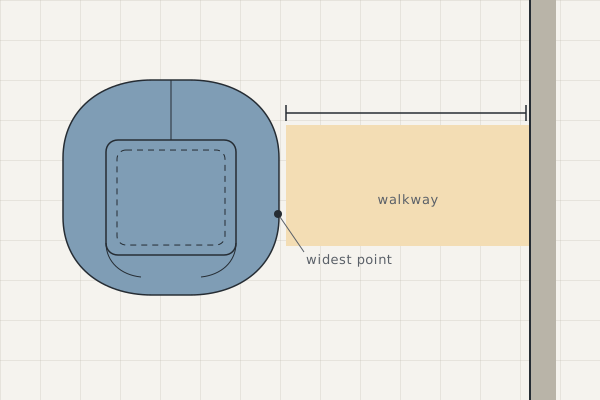
Where it fits, though, a rounded chair can do more visual work than a quieter shape. That can be valuable in a small room, where every piece should have a reason for being there.
A substantial chair can be the better small-room choice
There is a temptation to solve every small room with increasingly slight furniture. Eventually the room stops looking spacious and starts looking underfurnished.
One generous chair can sometimes be more convincing than a pair of underscaled ones. It gives the seating arrangement a clear hierarchy and avoids spending floor space on several pieces that each contribute very little.
This is where Fit has to remain ruthless. A substantial chair only works if its footprint, approach, and surrounding route still work. If it forces people to turn sideways to pass or makes the seat awkward to reach, visual confidence is not enough.
But when the room can afford it, scale can be deliberate rather than apologetic.
A swivel chair earns its keep when the room has two directions
Some small living rooms ask one seat to face more than one thing: the sofa for conversation, a window during the day, or a screen from another angle.
A swivel base can make that changing orientation part of the chair’s job rather than a reason to drag it across the floor. That is a Flow advantage, not a claim that swivel chairs take less space.
They may actually need more usable space around them because the chair changes orientation. Check the chair in the positions you expect to use, not just the neat position shown in a product photograph.
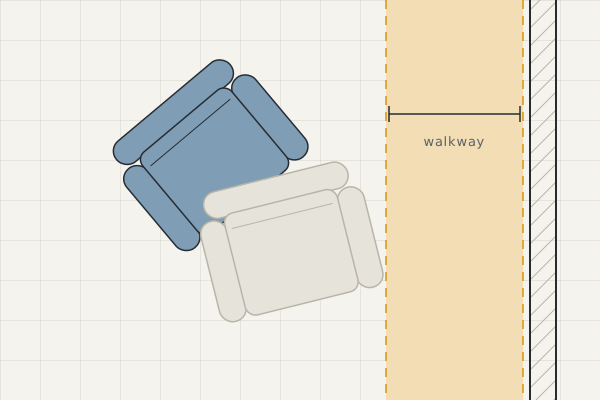
Where those positions stay clear, the ability to turn can make one seat more useful than another fixed chair in the same spot.
The best chair solves the room around it
No universal accent-chair type fits every small living room.
Start with the physical question: does the chair fit, can you get into it, and can you still move through the room? Then look at what the room already has too much or too little of.
A heavy sofa may want a chair with visible floor beneath it. A room built from hard rectangles may benefit from a rounded silhouette. A sparse arrangement may need one chair with enough presence to anchor it. A room used in two directions may justify a seat that turns.
The useful choice is not the chair that occupies the least space on paper. It is the one whose space you can afford — and whose presence gives something back.