 fairfits.co
article · nightstand width · 6 min read
How wide should a nightstand be beside a queen bed?
A nightstand meant for a bed has a lot to prove. The useful measurement is the strip between the assembled bed and the wall, because that same strip has to pass two separate tests.
The strip beside the bed has two jobs
The bedside strip is easy to misread. You see open floor beside the bed, put a nightstand into it, then assume whatever remains is the walkway.
That is not quite how the room works.
The nightstand occupies the head end of the strip. The walking route runs along the side of the bed. They overlap in the room's width, but they are not stacked end to end like blocks in an equation. So this page makes two checks instead: is the side strip wide enough to function as bedside clearance, and is the nightstand narrow enough to fit within that strip?
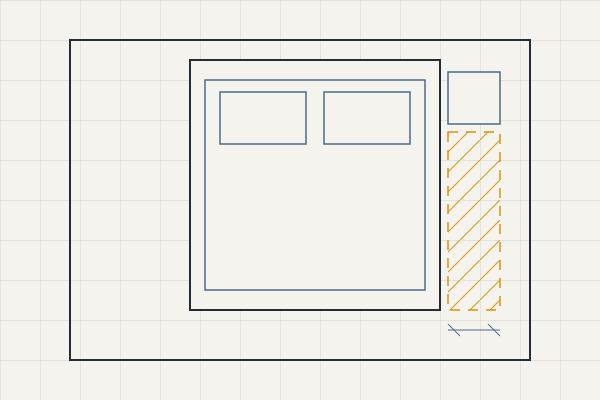
That distinction matters in a small bedroom. A slim table does not rescue a side of the bed that was already too tight to walk.
Start with the bed, not the nightstand
A nominal queen mattress is 60 × 80 in, but the mattress is only the baseline. If the assembled frame extends beyond it, use the frame's outside width instead.
Subtract that width from the room width. What remains is all the floor beside the bed. If both sides are meant to work, split that remainder between them. If the bed is against one wall and only one side is active, do not split it; the usable side gets the whole remainder.
Using the nominal queen mattress as the baseline, a centered bed changes quickly as the room narrows. The three callouts below are editorial working, not clearance standards.
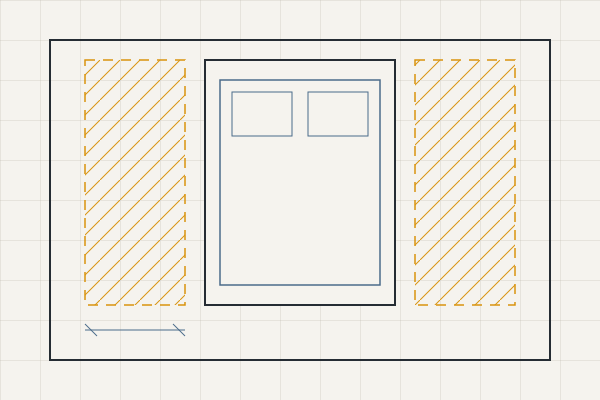
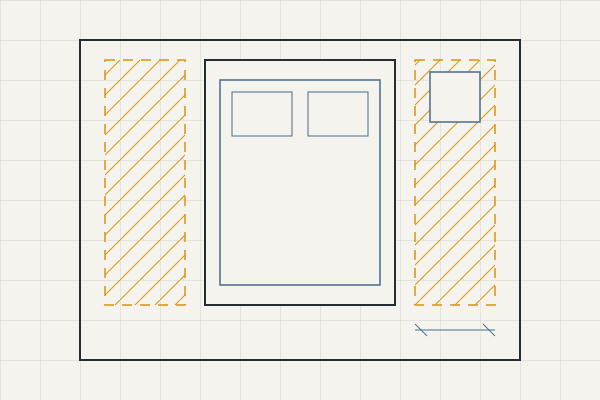
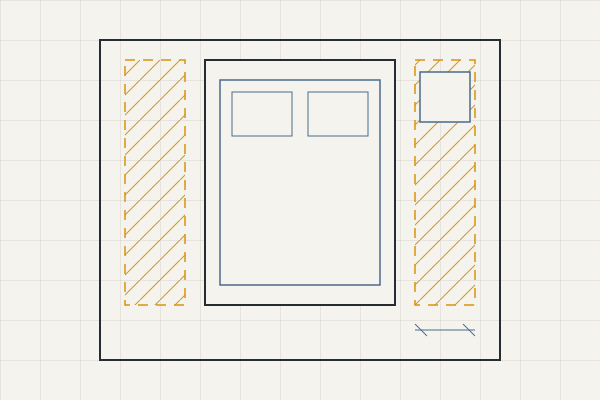
The last example is the useful one. Furniture can physically occupy the gap while the room still fails the way you need to use it.
Nightstand width is the second check
Once the side strip passes the walking-space test, compare the nightstand's listed width with that strip.
This is a geometric check, not another clearance rule. No universal standard says a nightstand should be a particular width beside a queen bed. The room decides.
A wider table simply uses more of the wall space available at the head of the bed. It does not change the clearance requirement along the side. That is why the same queen can take a substantial nightstand in one bedroom and reject it in another.
Measure the assembled bed. Measure wall to wall. Let those two measurements tell you how much nightstand the room has earned.
One walking side changes the answer
Centering the bed is not mandatory.
When a small bedroom cannot support two useful sides, pushing the bed toward one wall can turn two compromised strips into one working one. Instead of dividing the leftover floor between both sides, the usable side gets it all. That relationship is editorial arithmetic rather than a separate clearance standard.
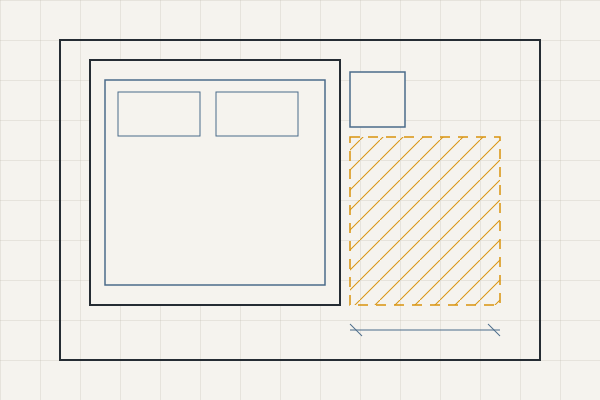
That can make room for a nightstand that looked impossible when the bed was centered. It can also make the everyday route easier because the floor is concentrated where you actually stand, get in and out, and make the bed.
The cost is obvious too. The wall side stops being a normal approach to the bed. If two people use it, one of them has accepted the awkward side.
No arithmetic makes that trade disappear. Choose it on purpose.
Width and height solve different problems
A nightstand can be the right width and still be the wrong nightstand.
Width answers whether it fits the wall beside the bed. Height answers whether the top lands where your hand expects it when you are lying down. Those are independent checks.
The height test starts at the top of the mattress, not the floor alone. That is covered separately in *How tall should a nightstand be?*
Do not use height to justify a table that crowds the room, or width to justify one you have to reach down for every night. Small furniture still gets more than one dimension.
Take three measurements before you shop
Measure the bedroom wall to wall across the head of the bed. Measure the assembled outside width of the bed frame. Then decide whether you genuinely need a walking side on both sides of the bed or only one.
From there, the room does most of the shopping for you.
First protect 24″ where you intend to walk; 30″ is the easier everyday target. Then compare each nightstand's width with the side strip the room actually leaves.
The useful question is not how wide a nightstand should be beside a queen.
It is how much wall this queen, in this room, leaves for one.