 fairfits.co
article · rug size · living room layout · 10 min read
What Size Rug Goes Under a Sofa?
A rug can reach under the sofa and still make the whole seating group look pinched. Start with the sofa’s actual width, then give the rug enough room to extend past it without borrowing the walkway.
The sofa gives the rug its first dimension
A living-room rug, viewed in the room, behaves more like a margin around the seating group.
That is why choosing from the rug label alone is backward. Start with the widest anchor in the arrangement — usually the sofa — and measure the sofa itself from outside edge to outside edge. The rug has to do more than disappear under the front feet. It needs enough width to show beyond the sofa so the sofa looks held by the rug rather than balanced on top of it.
No building standard covers that proportion. This page uses the site’s rug-sizing convention: extend the rug past both sofa ends, then judge the rest of the seating group from there.
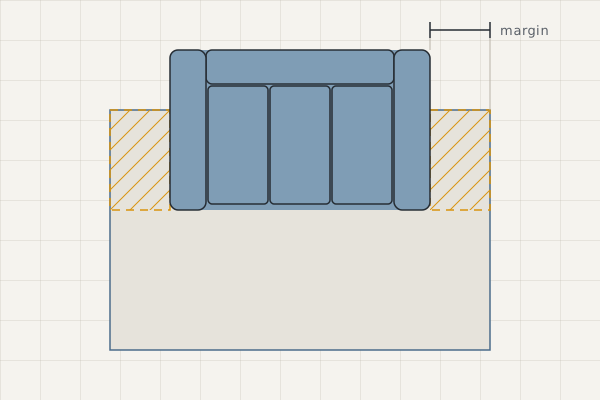
Measure the sofa first. The rug size follows from the piece that has to sit on it.
Let the rug pass the sofa ends
A rug that stops exactly at the sofa arms tends to look like a platform cut to the furniture. A little extra width changes the relationship: the sofa sits inside a larger field instead of defining the rug’s edge.
The site’s more generous editorial target scales the rug to the sofa rather than adding the same fixed amount to every piece.
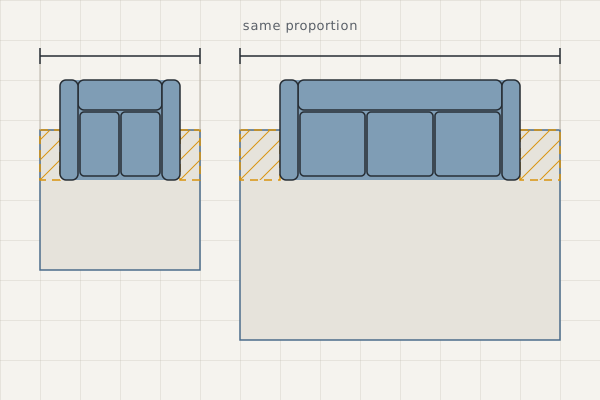
The fixed side margin and the proportional check do different jobs. The side margin keeps a narrow sofa from ending flush with the rug. The proportional check keeps a long sofa from swallowing a rug that technically clears each arm but still looks undersized.
Use both as planning checks, not as claims that one proportion is universally correct. No design standard publishes a single sofa-to-rug ratio.
And use the rug’s listed finished dimensions, not just the category name. A rug sold under a familiar size can finish a little shorter or narrower than the label suggests.
Front legs on is a useful small-room placement
Putting the sofa’s front legs on the rug is not the consolation prize for a room that cannot take a huge rug. It is often the useful arrangement.
The rug reaches far enough under the sofa to connect the two objects, while the rear of the sofa can stay on the floor. That preserves more uncovered floor behind the seating group and keeps the rug from spending area where nobody sees or uses it.
The important part is that the placement looks intentional. The front legs should sit comfortably inside the rug, not catch the edge by a token amount. If a chair belongs to the same conversation area, treat its front legs the same way when the room allows.
This is where Flow starts to matter. A rug can fit the sofa and still be wrong for the room if pulling it forward interrupts the route to a chair, a door, or the spot where the coffee table needs to sit.
Put the sofa first. Slide the taped rug outline under the front legs. Then walk the approach to every seat before deciding the placement works.
Rug depth decides what belongs to the group
Width answers whether the rug is broad enough for the sofa. Depth decides what else it can gather.
A shallow placement may connect only the sofa and the nearest part of the coffee-table zone. A deeper rug can bring the chair fronts into the same field and make several separate pieces read as one seating group.
Bigger is not automatically better. In a small living room, the rug is another object taking up floor space. A deeper rug can improve the composition while also pushing an edge into a route that worked perfectly well on bare floor.
So decide what the rug is meant to hold together. If the sofa and chairs are one conversation group, tape the front-leg positions of all of them. If the room is really a sofa plus one occasional chair off to the side, forcing every leg onto one large rectangle may spend more floor than the relationship needs.
Form gives you the reason to choose among the layouts that fit: the larger rug creates one stronger field; the smaller one leaves more negative space and lets separate pieces stay separate. Neither is a clearance rule.
Choose the relationship first, then measure the depth that relationship actually requires.
The rug still lives in the walkway
A rug does not cancel the floor underneath it.
If the room’s main route crosses beside the seating group, that path still needs its usable width. The rug can occupy the same floor, but its edge, pile, and corners become part of the walking condition.
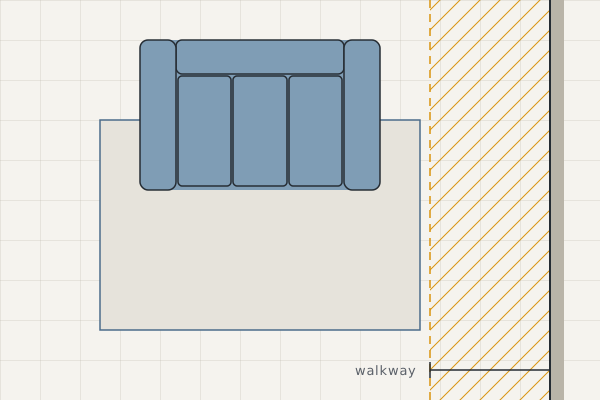
This is why the edge sometimes matters more than the overall footprint. A flat rug that lies cleanly across the route can feel almost invisible underfoot. A thick pile or curling corner can make the same layout annoying every time you cross it.
Look at where your feet actually pass, not where the plan looks symmetrical. If the natural route clips one rug corner, either move the rug, change its size, or change the route. Do not count a clear walkway on paper while putting the awkward part of the rug exactly where everyone steps.
When two sizes fit, choose the room you want
Once two rug sizes both clear the sofa and preserve the route, the decision stops being arithmetic.
The smaller rug exposes more floor. That can help a tight room keep some visual breathing room, especially when the sofa and coffee table already carry a lot of mass. It can also make the seating group feel fragmented if the chairs hover outside the rug and the rectangle reads as something belonging only to the sofa.
The larger rug does the opposite. It can pull the sofa, chair fronts, and table into one field, making the arrangement read as a single room within the room. But it gives up more visible floor and may make a compact space feel fully occupied.
Neither outcome is automatically better. Look at the other pieces.
A substantial sofa with a low, open coffee table may benefit from a broader rug that ties the group together. A lighter sofa with exposed legs may not need as much rug to establish the relationship. Color and contrast matter too: a rug close to the floor tone can recede, while a high-contrast rug makes its full rectangle more visually present.
Fit decides what the room can take. Flow decides where the workable rug belongs. Form decides how much of the room you want that rug to claim visually.
Tape the rug before you buy it
Measure the sofa at its widest point. Work outward from that width using the site’s side-margin convention, then compare the result with the actual finished dimensions of the rug you are considering.
Tape the rug outline on the floor. Put the sofa’s front legs where they would sit. Add the chair fronts if they belong to the same group. Place the coffee table where it actually works, not where the product photo suggests it should go.
Then walk the room.
If the taped edge cuts through the route, the rug is too large for that placement even if the sofa looks good on it. If the sofa consumes the rug from end to end, the rug is too small for the relationship this page is trying to create.
A useful rug makes the seating group feel deliberate without taking floor space the room still needs.
Take those actual dimensions to the rug hub and check the arrangement against the room, not the rug label.