 fairfits.co
article · TV stand size · living room layout · 9 min read
What Size TV Stand Do You Need for a 65-Inch TV? Start With the Sofa
A television can fit the wall and still take over the room. Start with where the sofa belongs, then size the screen and media console around the way the room actually works.
Start with the room as it is lived in
A television can fit the wall and still make the room feel wrong.
You notice it when the sofa gets pushed somewhere awkward, the route behind it narrows, or the screen becomes the one object every other piece has to answer to. None of those problems show up in the television's diagonal.
Start with the room as it is lived in. Give the sofa a position that feels supported, leaves the main route intact, and makes sense for conversation as well as viewing. Then work out what the television and its stand can ask from the space that remains.
A useful modern feng shui reading arrives at much the same principle: place the people first, then the screen. It is not an ancient rule about televisions. It is a way of keeping the room's occupants and circulation more important than the electronics.
The measurements come next.
A 65-inch TV is not as wide as its number
Television size is measured diagonally, not from side to side.
For a standard 16:9 screen, a 65-inch diagonal works out to a screen rectangle about this wide:
That does not mean the stand must be that wide.
The television may sit on two feet well inside the edges of the screen, on a central pedestal, or on a separate mount. The stand has to support the base the television actually uses. Its surface also needs enough depth for that base to sit fully and securely.
So the first sizing instruction is simple: check the television's overall width, foot spacing, and base depth before choosing the stand.
There is no universal rule that says a 65-inch television requires a particular console width. A stand can be narrower than the television and still support it correctly. A wider stand can give the composition more breathing room.
Once the television physically fits, the more interesting question is what the console does to the room.
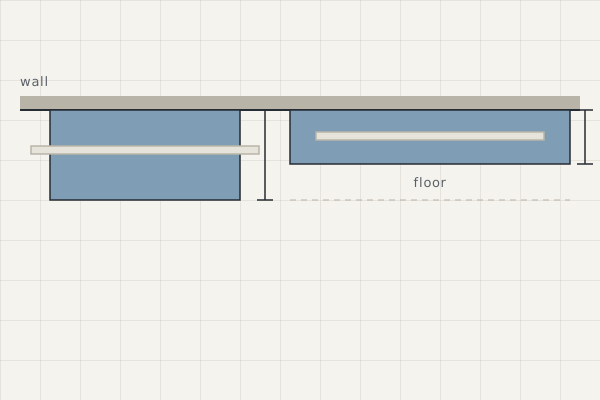
Width fits the TV. Depth fits the room.
A media console looks like a wall problem. In a small living room, its depth is a floor problem too.
Width determines how much wall the piece occupies. Depth determines how far the arrangement reaches into the room.
That distinction becomes important when two consoles solve the same television in different ways. One can be relatively compact across the wall but project farther into the floor. Another can be substantially wider while staying shallower.
Neither is automatically better.
The right trade depends on what the room has more of: wall or floor.
If the sofa already sits close to the television, a few inches of console depth can matter more than another foot of width. If the wall is interrupted by a doorway, radiator, or another piece of furniture, width may become the tighter constraint.
Measure both.
Start with a viewing band, not a magic spot
The sofa does not have one ordained place in front of a television.
This page uses the site's sourced seated_viewing_distance ratio as a range. Applied to the screen size in this question, it gives you a near end and a far end rather than a single line on the floor.
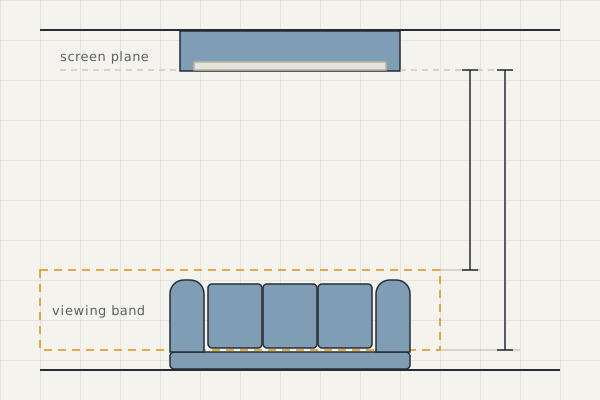
The distinction matters.
At the near end, the screen occupies more of your field of view. Move toward the far end and it becomes less dominant. Neither end tells you where the sofa must go.
Treat the band as the part of the room worth testing.
Then let the room have a vote.
Measure from the screen, not the wall
A tape measure against the wall can flatter a room.
The useful distance starts at the plane of the screen and ends where you actually sit. If the television stands on a console, the screen may already be forward of the wall. Your seating takes up space at the opposite end too.
That is why a room can sound generous by its wall-to-wall dimension and still feel tight once the furniture arrives.
If the screen is wall-mounted, measure from the screen itself. If it sits on a console, measure from its actual position rather than pretending the wall is the picture.
Do the same at the sofa.
You are arranging a viewing position, not the front edge of an upholstered box.
The media console spends room length
The site's calculator works backward from the room:
room length − console depth − seating depth = space available between them
That remaining distance is what gets compared with the screen diagonal.
A shallower console therefore buys something very specific. It does not make the television smaller or the room wider. It gives some of the room's length back to the relationship between the screen and the seat.
Wall-mounting changes the equation. A deep console beneath a wall-mounted television still occupies floor space, but it does not necessarily push the screen plane forward by the same amount.
Measure the arrangement you actually intend to build.
Do not sacrifice the room to hit the far end
It is possible to solve the television and make the living room worse.
Pushing the sofa farther back may move the seat neatly through the viewing band, but the sofa still has a back, and the floor behind or beside it may already be doing another job.
If the room's main route passes there, protect that route first. 30″ belongs to circulation; viewing guidance does not get to erase it.
This is where Fit and Flow separate cleanly.
The television can fit. The viewing distance can work. And the sofa can still be in the wrong place.
A route that pinches behind the sofa, a doorway that opens into its corner, or an awkward detour around the seating group remains an arrangement problem even when the screen-to-seat measurement looks perfect.
Move within the viewing band where the room allows it.
Do not chase its far edge simply because the floor exists.
A small room gives you more than one lever
When the available distance falls short, the sofa is not the only thing that can move.
A smaller screen shortens the viewing-distance band. A shallower console gives some room length back. Wall-mounting may move the screen plane toward the wall. A different seating position can change the relationship without replacing either piece.
Those choices do different things to the room, which is why "buy a smaller TV" is not automatically the right answer.
A large screen can be perfectly reasonable in a small living room when the viewing position and circulation both work.
A smaller screen can still be badly placed.
Start with the relationship, not the category label.
Tape the screen and the sofa into the same plan
Before moving furniture, mark the intended screen plane and the near and far ends of the viewing band on the floor.
Then place the sofa where you would actually use it.
Check the door. Walk the main route. Look at what has to live behind or beside the seat. If the television will sit on a console, include the console at its real depth rather than measuring from the wall.
Then check the television's feet or base against the stand itself.
What remains is the useful answer to "What size TV stand do I need?"
Not one universal width for every 65-inch television. Not a viewing-distance number taken out of context.
You need a stand that supports the television you own, uses the wall you have, and takes no more floor than the room can comfortably give it.
Place the people first. Fit the furniture around them. Then let the measurements prove the arrangement works.