 fairfits.co
article · bedroom benches · 7 min read
Is there room for a bench at the foot of your bed?
A bedroom bench offers a tempting home for the blanket that never stays folded. Before adding one, measure the floor beyond the bed, subtract the bench’s full depth, and check that you can still walk past and open its storage.
Measure what is left beyond the bed
Start at the bed’s outermost edge and measure to the nearest wall or furniture opposite. A projecting footboard counts; so does a dresser on the far wall. The bed-frame size guide explains where to start when the frame and mattress end in different places.
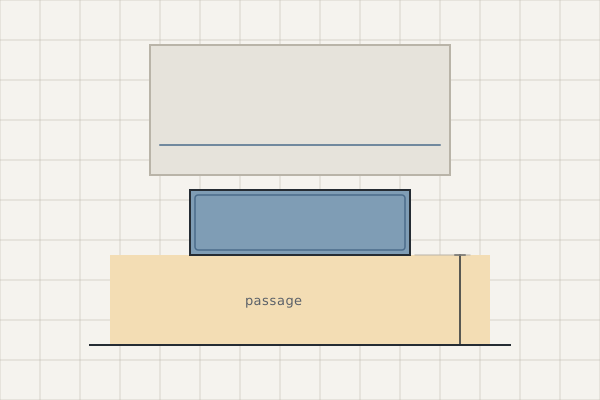
Subtract the bench’s full outside depth, including projecting legs, handles or upholstery, and any gap you plan to leave between it and the bed. The remainder is the passage beyond the bench. Measure at the tightest point along the route, especially where you turn around its ends.
The foot-of-bed planning reference is 24″ at minimum, with 30″ recommended. Apply that check to the floor left after the bench goes in. Below the minimum, passing the foot becomes a squeeze. If this is the room’s main route, use the wider passage check below.
Check the room in the direction the bed runs
For a worked example, put the head of the bed on the longer wall in each of the rooms below, so the bed projects across the shorter room dimension. Assume a clear wall opposite. The furniture dimensions and gaps below are editorial assumptions.
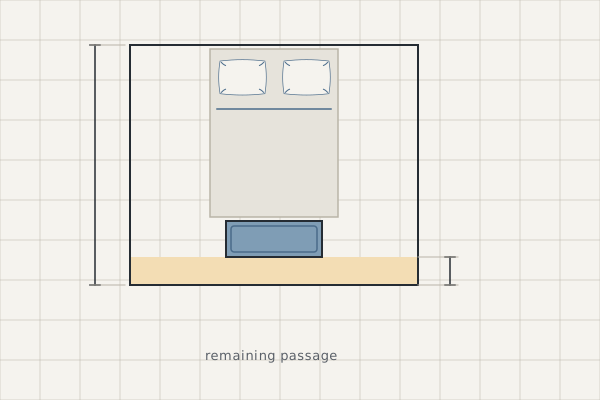
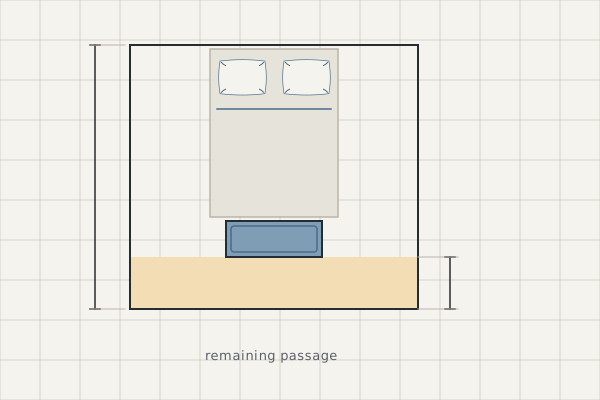
Replace every assumption with your own measurements. The shorter room fails the foot-of-bed minimum; the longer one clears the minimum but falls short of the recommendation. Neither supports the recommended main route with this bench.
Orientation matters. If both beds run along the longer room dimension instead, their foot-space arithmetic is identical. Turning the bed may help, provided the new position preserves the bedside approaches and the door’s swing.
Keep the route through the bedroom
Trace the trip from the door to the closet and around to the far side of the bed. If it passes the bench, aim for 36″ of continuous clear passage. The tighter 30″ reference describes an unobstructed single lane; it is not an allowance for an open drawer or someone’s knees.
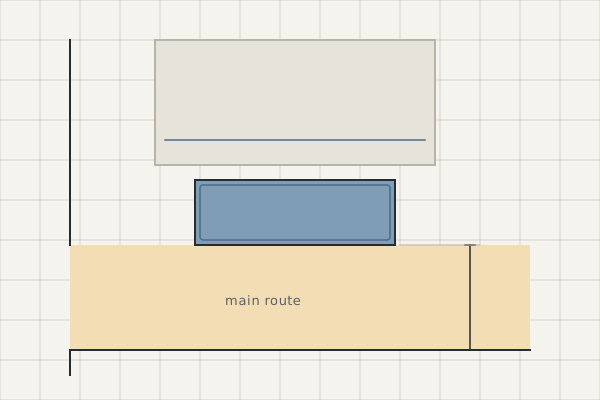
Walk the taped arrangement carrying a laundry basket. Then try sitting where the bench would be, with your feet on the floor. Your knees and the movement of standing up occupy space beyond the furniture’s outline. Where someone needs to pass an occupied seat, check that passage separately.
A shorter bench can help you turn around the bed’s corners, but it does not widen the strip directly in front. If the bench makes every trip to the closet a sideways turn, choose a shallower piece or keep this floor open.
Choose storage you can actually open
A lift-top bench avoids sending a drawer into the passage, but its lid still needs room to rise beside the bedding or footboard. Check the exact model’s opening movement and required rear gap. A removable lid needs somewhere to rest while you reach inside.
Drawers let you reach the contents without clearing the seat. Their cost is floor in front: mark the fully extended drawer and try reaching into it from a position you can actually use.
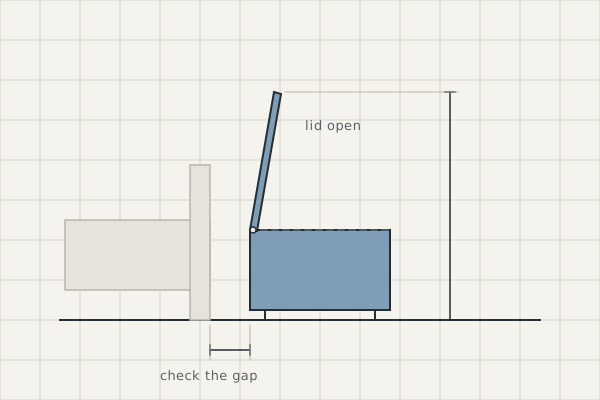
Think about what goes inside. A spare blanket used occasionally may suit a lift-top compartment. If getting dressed means moving cushions, lifting the lid and blocking the only route, the extra storage may work better elsewhere.
Let the bench belong to the bed
Choose seat height by trying the movement of sitting down and getting up. Mattress height is a visual reference, not a seating prescription, and a storage chest should only double as a seat when its maker specifies that use.
A bench below the mattress top can leave the bed’s outline visible above it. A taller, closed piece adds another substantial face across the room. Compare it with the footboard from the doorway: the pair may repeat more bulk than you want.
A solid base can conceal blankets that would otherwise gather on a chair. An open base shows more floor but may offer less enclosed storage. A shared wood tone, fabric or shape can connect either choice to the bed without requiring a matching set.
Before ordering, mark the bench’s width and depth, check the seat height, and rehearse opening it. Leave the outline down through an ordinary morning. The walk to the closet and the way you put on your shoes will tell you whether the bench earns its floor.