 fairfits.co
article · nightstand alternatives · 8 min read
When there’s no room for a nightstand
The bedside is a good place for a piece you simply like. A narrow pedestal can bring a curve beside a broad upholstered bed; a wooden stool can repeat the frame’s grain without adding another cabinet.
Let a narrow table have presence
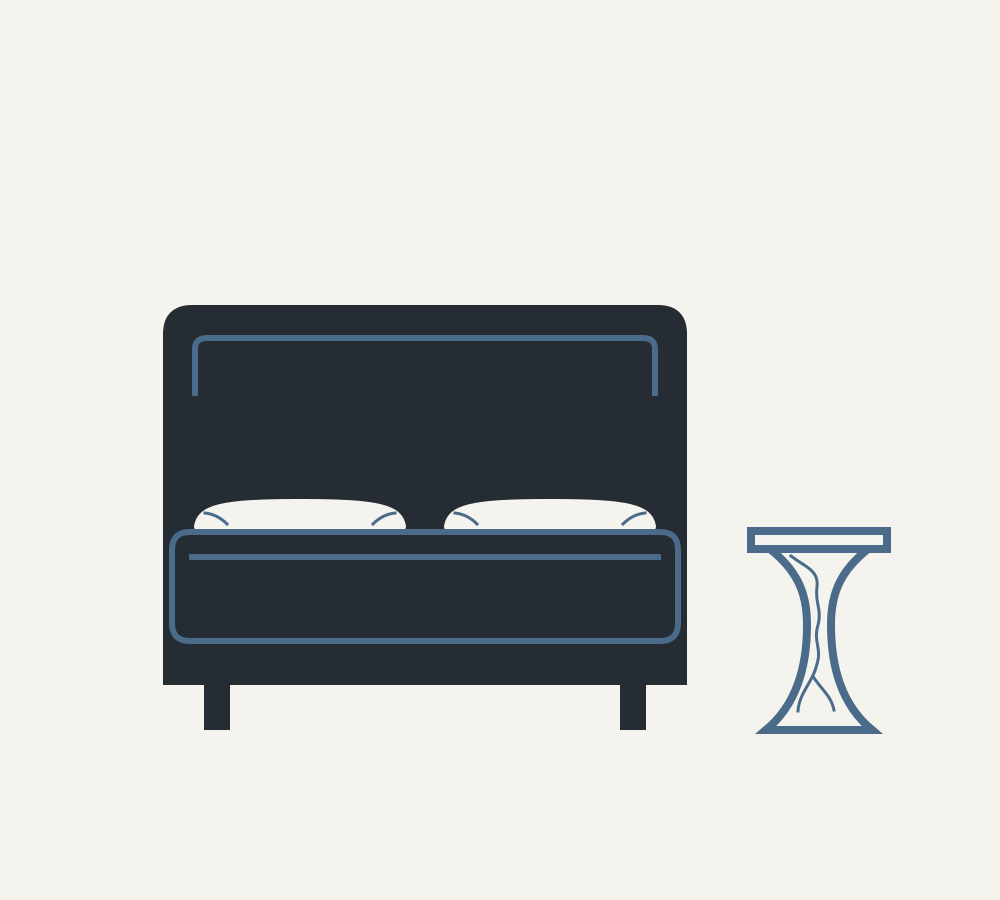
An upholstered bed already brings a broad, soft shape to the room. Beside it, a marble pedestal offers a different outline: a small top, a curved stem and a base that widens toward the floor. The veining gives you something to notice up close; the silhouette is what you read from the doorway.
That is a reason to choose the table beyond its width. Pale stone can pick up a tone in the bedding while the curve supplies the difference. Dark stone can make the same small piece more emphatic against a light bed. Choose according to whether you want that bedside to blend in or catch your eye.
A narrow stem does not mean a narrow footprint. Measure the widest parts of both top and base, then check that the surface holds your nightly essentials without crowding them against the edge. You give up the drawer. If storage already lives elsewhere, the material and shape may be worth choosing for themselves.
Keep the bed visible through an open frame
A slim C-table leaves much of the bed’s side and the floor visible through its frame. That can be useful beside a thick upholstered rail: the table adds an outline without another solid face. A dark metal frame can repeat the line of the bed’s legs or a reading light.
The shape also has a practical job. Its base slides beneath the bed so the top can reach over the edge. Check under the rail, between the supports and above the mattress; a wide bed frame can stop the upright before the top reaches where you want it. These are editorial compatibility checks, not a universal allowance.
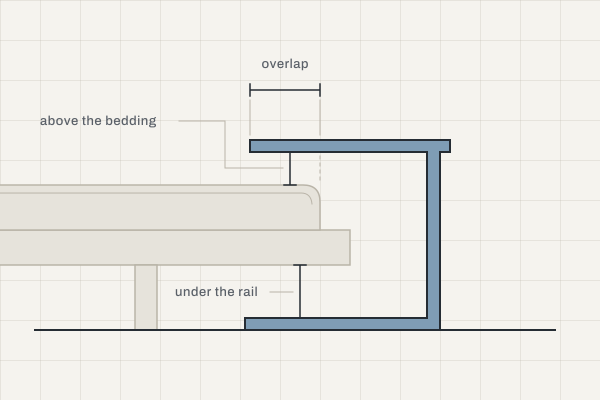
Keep the opening under the table in mind when deciding what goes there. A basket of chargers fills the space that made the frame appealing. If you need to move the table to get out of bed, give it a parking place that leaves the route open.
Let a shelf continue the bed’s lines
A shallow shelf draws a horizontal line beside the mattress and leaves the wall and floor below exposed. In the same finish as a wooden bed, it can look like a small continuation of the frame. Against the wall in a similar color, it can recede and leave more attention with the headboard.
Its contents become part of that line. A lamp, books and charging cables can make a modest shelf look busy; choose it when the things you leave out are few enough to sit comfortably together.
Mock up the complete shelf with cardboard and test its height and projection from bed. The mattress top is an editorial starting reference for reach, not a prescribed mounting height.
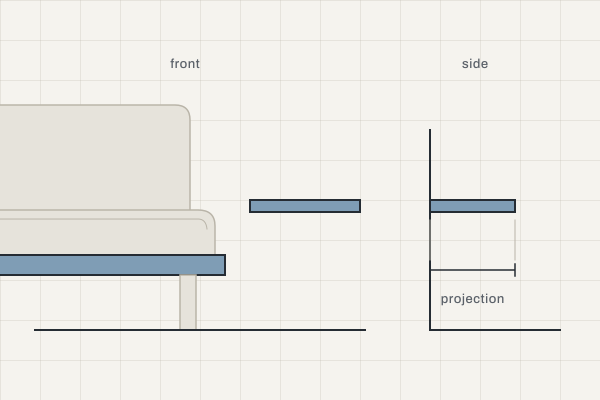
Follow the shelf’s instructions for the wall construction, fixings and load. If drilling is not an option, choose a freestanding piece. The trade is a fixed position: rearranging the bed may mean remounting its companion.
A stool brings a different kind of familiarity
A wooden stool can carry something of the bed into a smaller piece. Beside a thick timber frame, a substantial seat repeats that solidity without extending it into another cabinet. A round seat also breaks the run of rectangular edges; choose a related wood tone if you want the change in shape to be the thing you notice.
Try one you already own. Check the seat as a surface: deep shaping or gaps may make it awkward for a glass, and splayed legs can reach beyond its apparent width. Check the height from bed too.
It leaves you free to rearrange the bedside, but gives up concealed storage. If the nightly pile spills onto the floor, a stool is asking you to live with less storage than you use.
Give different pieces something in common
The sides of a bed can have different needs. A drawer cabinet may serve the person who keeps more beside them, while a narrow accent table holds enough on the other side. The one-nightstand guide works through the surface and access each sleeper gives up.
A shared material, tone or detail can connect those unequal pieces. A pale stone top might pick up the cabinet’s light finish while its curved base changes the outline. Decide which relationship you want to notice; matching the lamps as well is a choice, not a repair.
Judge the arrangement with its ordinary belongings in place. A closed drawer adds a solid face but conceals what an open shelf displays. The emptier-looking product photograph does not tell you which will look quieter in use.
Keep the space usable
A table fitting at the head of the bed does not prove that the approach works. The nightstand-width guide checks these separately. Measure from the outermost bed edge, keeping 24″ along a side you use to approach the bed; 30″ is the more comfortable target. Below the minimum, getting alongside becomes a squeeze even with a tiny table.
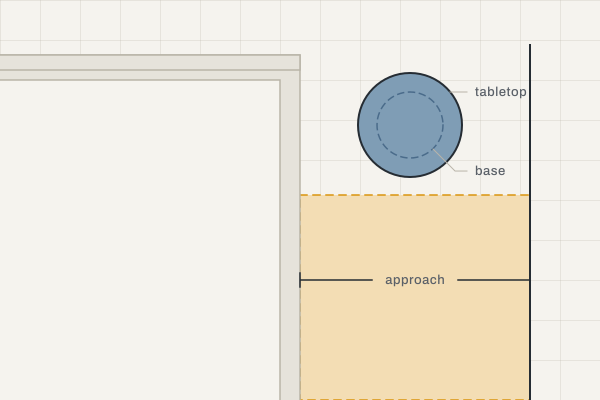
Keep the place where you sit and put your feet down unobstructed. Check reach with the bedding in place, and account for any lamp base and cords. If nothing works there, leave the spot empty and give the essentials another home.
Before ordering, mark the footprint and mock up the top. Look from the doorway, then lie down and reach for your glass. You should be able to see what you liked about the piece and use it without rearranging the bedside.