 fairfits.co
article · nightstand layout · 7 min read
One nightstand or two?
Matching nightstands can make a bed look settled. The useful check is the strip beside each side of the assembled frame: if both strips work, two tables are a choice; if one side fails, symmetry is spending floor the room does not have.
What the pair costs
Two nightstands do not automatically cost two walkways. The geometry is a little stranger than that.
A table occupies the head end of the strip beside the bed; the approach runs along the side. That is why the nightstand-width guide treats them as two checks rather than subtracting the table from the walking space. First, the whole bedside strip has to work. Then the nightstand has to fit within the wall space that strip leaves at the head.
Start with a centered queen in a nine-foot room. Using the nominal mattress width as the working width, the arithmetic lands here before a bed frame adds anything:
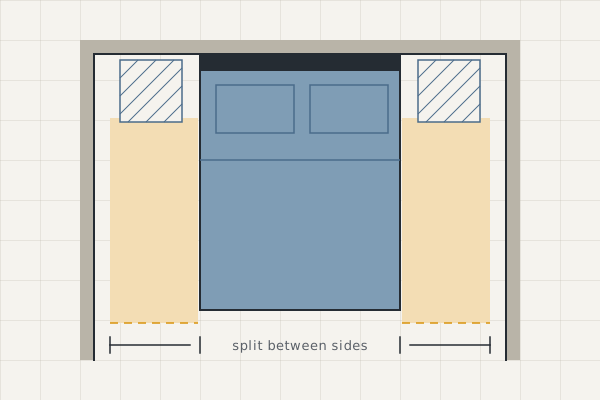
That result already sits in the minimum bedside-clearance tier. Any rail, upholstery, or frame edge extending beyond the mattress counts on both sides.
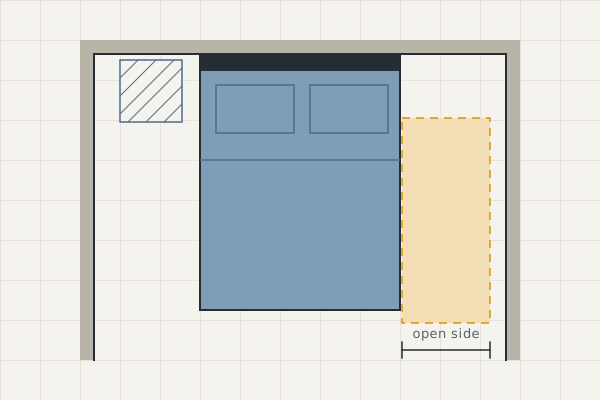
This is where “it fits” gets misleading. A nightstand can fit geometrically at the head of a side strip while the assembled bed leaves too little floor for that side to work properly.
The nightstand did not break the walkway. The commitment to two usable sides did.
One nightstand can look intentional
Removing one table should not leave you with a bedroom that looks as though the second one has not arrived yet.
The useful version of asymmetry gives the open side another reason to be open. A window can occupy that part of the wall. Artwork can pull the composition upward instead of putting another box on the floor. A wall-mounted light can provide a vertical counterpoint without quietly replacing the missing nightstand with a different piece of furniture.
The relationship matters more than matching. One solid table beside the bed and deliberate negative space on the other side can read as a choice because the two sides are doing different jobs.
Be suspicious of the urge to “balance” the empty side with a stool, floor lamp, or small cabinet. The moment another floor-standing piece goes there, it enters the same room arithmetic the second nightstand did. You may have restored symmetry by another name.
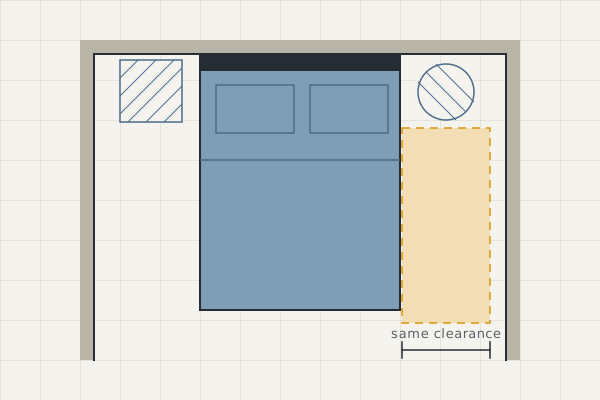
One table earns the arrangement when the open side is useful as open floor or when a fixed feature already gives that side visual weight. If nothing changes except the furniture count, the room has gained less than it appears to.
The missing table has a cost
A second nightstand is not decorative duplication when two people use the bed.
Two sleepers may want two independent surfaces. Two phones do not become one because the room is small. Removing a nightstand means somebody gives up that surface or shares the one on the other side.
The larger spatial move can cost more. If dropping the second table lets you move the bed toward a wall and concentrate the leftover floor on one useful side, the room may gain a much better approach. But the wall side then stops being a normal approach. The wall-side studio layout makes that trade directly: one strong route in exchange for one lost side.
That distinction matters. A centered bed with one nightstand does not magically make its bedside strips wider. It simply leaves one head-end patch of floor empty. To gain meaningful walking room, the bed itself usually has to move.
So name the bargain accurately. One nightstand can buy flexibility, open floor, and a stronger single approach. It also gives up a surface, and sometimes an approach.
When two still wins
If the assembled bed leaves a working strip on both sides and two people use those sides, a pair is not inherently wasteful.
In that room, two nightstands can be the straightforward answer: each sleeper gets an approach and a surface, and neither side has to pretend it serves the whole bed. The fact that an asymmetric arrangement can work does not make symmetry a mistake.
No clearance standard decides whether a bedroom should have one nightstand or two. The standards can tell you whether the floor works. They cannot tell you how many bedside surfaces your household uses or whether a visually balanced pair matters enough to spend the wall on it.
That is why “small room means one nightstand” is too crude. So is “a proper bed needs two.”
If both sides pass and both surfaces have a job, keep the pair. If the second table exists mainly to complete a set while one approach gets squeezed, drop the set.
Run the strip before you choose
Measure the room across the head of the bed, then measure the bed frame at its assembled outside width. Subtract the frame from the room.
If the bed is centered and both sides need to work, split what remains between them. Check those strips against the bedside clearance before choosing a table. Only after the floor passes should you compare a nightstand's width with the wall space available at the head.
If the room cannot support two useful sides, decide what you actually want to preserve. You can concentrate the floor on one approach, move the bed toward a wall, or keep the bed centered and accept that the second side is tight. Each solves a different problem.
Then decide whether the second nightstand has a job worth paying for.
One nightstand is not the small-room answer, and two are not the grown-up answer. The room decides how many approaches fit. The people using the bed decide how many surfaces are worth keeping.