 fairfits.co
article · studio bed placement · 7 min read
Should You Put a Bed Against the Wall in a Studio Apartment?
A centered bed is polite to a bedroom. In a studio, it can be an expensive habit. Pushing one long side toward the wall can turn two compromised strips of floor into one useful side of the room — but the side you keep and the foot of the bed still have to work.
Centering the bed is a choice
A studio has no reason to spend floor on symmetry for symmetry’s sake. When the bed sits in the middle of the sleeping end, every inch left over gets divided between its sides. Both strips may look respectable on a floor plan, and neither may be useful enough to walk.
Moving the bed toward a wall changes the bargain. One side stops being an approach; the other inherits the floor that used to be split between the two. The room has not become larger. It has simply stopped asking the same patch of floor to pretend it serves two people equally.
The open side still needs to work as a bedside route.
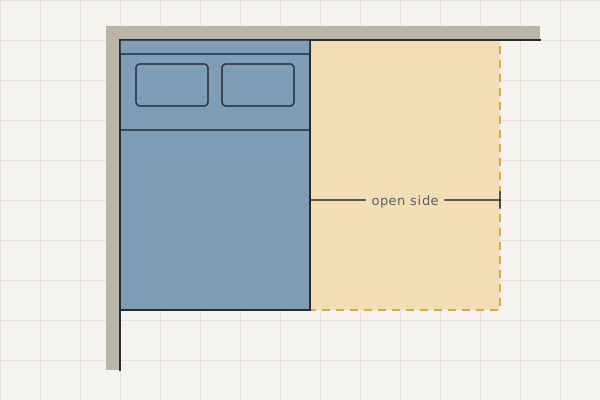
That is the first test. If the useful side still falls below the bedside clearance, pushing the bed over has rearranged the problem instead of solving it.
Give the useful side the useful floor
The open side should face the part of the studio you actually move through: the route toward the entry, closet, bathroom, or living area. Putting all the leftover floor on the wrong side of the bed produces a generous strip nobody needs and a daily squeeze somewhere else.
When the bedside strip is part of the studio’s main route, this matters more. Then it does more than help you get into bed.
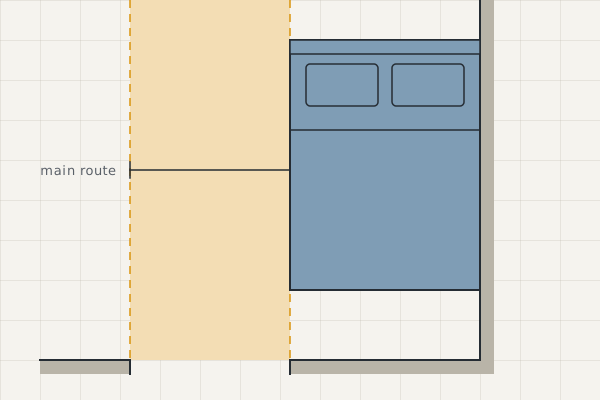
Think about the worst version of that route, not the empty-apartment version. Carry a laundry basket through it. Open the closet. Imagine a chair pulled out nearby. The useful layout is the one that survives ordinary life.
If a nightstand joins the open side, measure it after the route works. The nightstand-width guide starts with the same distinction: furniture can fit the gap while the gap itself fails as walking space.
The foot of the bed still counts
Pushing a bed sideways can make the middle of a studio look wonderfully open while quietly creating a pinch at its foot.
That strip often connects the sleeping area with everything else. A sofa, dresser, shelving unit, or divider placed opposite the foot must leave enough floor for the bed to remain usable, rather than becoming a barrier across the room.
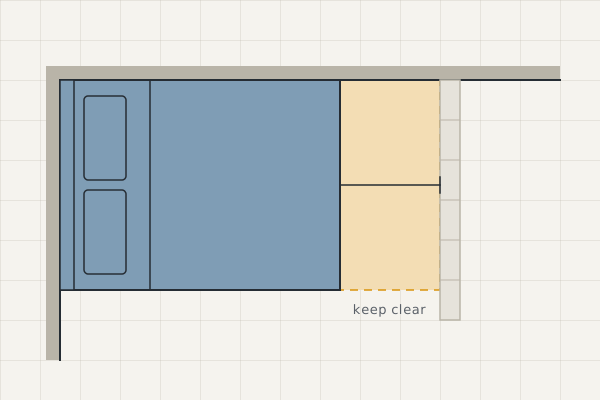
Measure from the assembled frame, not the mattress. An upholstered rail or footboard can extend beyond the nominal bed size, and those extra inches belong to the room once the frame is assembled.
The divider can go wrong here. Separation is useful; creating a narrow corridor between the divider and the foot of the bed is not. Zone the studio after the route works, not instead of it.
The wall side is the price
A bed against the wall gives something up. No arithmetic trick makes the inaccessible side accessible.
For one sleeper, that may be a cheap trade: one useful approach can matter more than two mediocre ones. For two sleepers, somebody gets the wall side. They cross the mattress to get out, and changing the sheets becomes a different job.
No universal rule says a bed must have two usable sides. Room conditions and household needs matter. If independent access on both sides matters every day, preserve it; if it doesn’t, spending scarce studio floor space on a ceremonial second aisle makes less sense.
That is the part a floor plan cannot decide for you. It can show which arrangements physically work. You decide whether the lost side is an inconvenience you are actually willing to live with.
Let the bed become an edge
Once the physical checks pass, a wall-side bed can do something useful for a studio’s composition: it turns the bed from an object floating in the middle of the room into an edge of a sleeping zone.
The change is mostly negative space. More continuous floor appears in the center, so the living part of the studio has somewhere to exist without circling the bed. That does not mean the smallest or palest bed frame automatically wins. A substantial bed can still work if its footprint leaves the route intact and its visual weight fits the rest of the room.
The useful question is not whether a studio bed should touch a wall. It is what the room buys with that move.
If the answer is one properly usable route, enough room beyond the foot, and a sleeping zone that no longer consumes the middle of the studio, the wall may be doing real work. If the only gain is a prettier floor plan while daily access gets worse, center the bed and spend the floor differently.
Start with the frame’s outside dimensions. Then draw the open side and the foot around it before you place anything else.