 fairfits.co
article · studio furniture · 6 min read
Can a coffee table be your desk? The lift-top question
A desk that disappears at dinner is an appealing roommate. A lift-top coffee table can give work a place inside the seating area, provided its raised surface suits your seat, leaves room for your legs, and keeps the route through the studio open.
Give work somewhere to disappear
A lift-top earns its place when work can leave the room without needing another room. Closing the laptop and putting it away returns a broad, low surface to the seating group. In a studio, that change can matter from the bed as much as from the sofa: the view no longer ends at an open workstation.
Prefer a table with concealed storage when the equipment you actually use fits inside it. A deep box may hide the laptop and charger, but its solid sides also give the center of the room more visual weight. An exposed base leaves more floor visible beneath the piece; it may offer less space to put work away. Choose against your contents and the view across the room.
The trade-off is the changeover. Books, cups, and anything sitting on the moving top need somewhere to go, following the maker's operating instructions. If work stays spread out all evening, the room has gained a desk in front of the sofa. Decide whether that is the room you want.
Check the table with its top down
Start with the ordinary seating arrangement. Measure from the sofa's front edge to the nearest edge of the closed table, including any overhang.
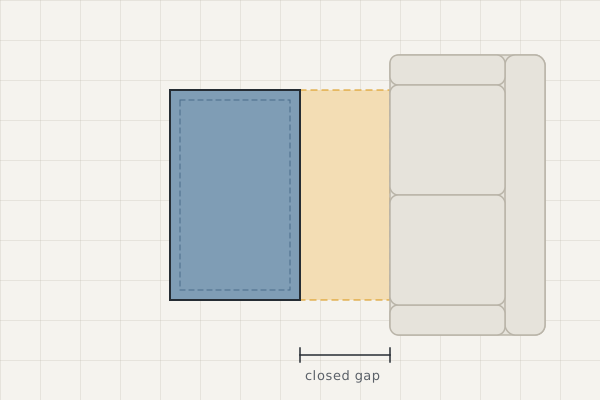
Below 16″, the table crowds the space where your legs go and makes sitting down or standing up harder. Aim for 18″ where the arrangement allows it. Moving the table farther away buys room in front of the seat but makes the surface harder to reach.
Mark the base and the closed top separately if their edges differ. The base stays on the floor when the top lifts; a raised overhang does not make the storage box underneath disappear.
Match the raised top to the person sitting there
Ask for the fully raised height, how far the top travels toward the seat, and the unobstructed space beneath its working edge. Closed dimensions cannot supply those answers. Check the maker's drawing for the mechanism as well as the top: a support arm can occupy space that looks empty in a photograph.
Here is an editorial working with assumed dimensions.
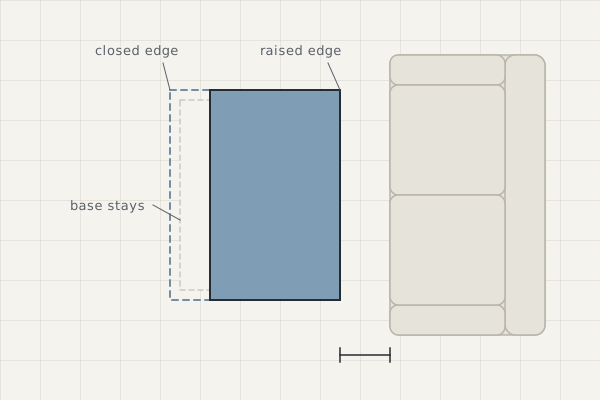
Substitute the actual closed gap and horizontal travel. Measure the underside separately, with someone sitting on the cushion, because the seat compresses under them.
OSHA's workstation guidance treats leg space, reachable equipment, and a suitable work-surface height as separate checks. Try the setup with your back supported, feet supported, and keyboard within easy reach. If reaching the top pulls you away from the backrest, or its height makes you raise your shoulders, the lift has not solved the working position.
A top with a fixed raised height gives you little adjustment. FairFits has no lift-top rule that certifies this combination of table, sofa, and person; the coffee-table gap cannot stand in for one. For a regular workday, favor a setup you can adjust to yourself. A successful trial of answering a few messages does not establish that the same seat works for the day.
Keep a route while someone works
Prefer an arrangement where the main route passes outside the working area. In a shared studio, that lets someone reach the bathroom or bed without asking you to lower the top. The cost may be moving the sofa away from a wall or leaving the seating off-center. Recheck the floor that move consumes.
For a local passage between furniture, use the secondary-walkway check.
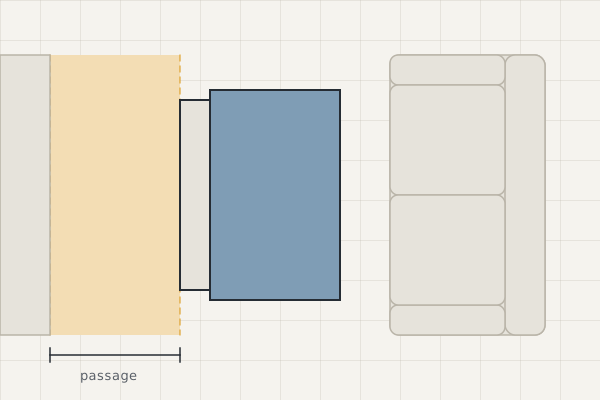
If that passage carries the studio's main traffic, use 30″ instead, aiming for 36″. A path behind the sofa can be the main route; its location does not make it secondary.
Trace the whole trip, including the turns around the sofa ends. Keep the charger out of it. The studio-zoning guide explains how a shared route can separate activities. Here, it needs to survive while work is happening.
Rehearse the changeover before choosing
Check the maker's raised-top load limit, opening instructions, and usable storage dimensions. Try the mechanism if you can. If using the table requires moving the whole piece, include its weight and the effort of moving it on your floor in the decision.
Then rehearse an ordinary sequence: sit down, open the table, arrange your equipment, get up while it is raised, and put work away. Have someone take the route past you. Include any separate chair and where it will live afterward.
Choose the lift-top when that sequence works and the cleared surface gives the room something you value. If the table stays raised, the chair has nowhere to go, or the working position never settles, reserve space for a desk and choose the coffee table for sitting around.